Foreign exchange trading and equity investing attract millions of participants worldwide, yet both arenas exhibit unique characteristics that can significantly influence your trading approach. Understanding the distinctions between these two financial domains is crucial for developing a sound strategy and achieving your financial objectives. This article explores the fundamental contrasts between Forex and stocks, examines the underlying structures of each market, and offers guidance on risk management and strategic considerations.
Understanding the Markets: Forex vs Stocks
The Forex market, also known as FX, is a decentralized global marketplace where currencies are bought and sold. With an average daily trading volume exceeding $6 trillion, it stands as the liquidity champion among financial markets. In contrast, the stock market consists of centralized exchanges—such as the New York Stock Exchange (NYSE) or the London Stock Exchange (LSE)—where shares of publicly listed companies change hands. Typical daily volume on major stock exchanges ranges from hundreds of billions to just over a trillion dollars, depending on market conditions.
One of the most striking differences lies in trading hours. Forex operates 24 hours a day, five days a week, enabling participants to react instantly to global events. Stock exchanges generally run on local business hours, meaning trading halts overnight or during weekends. As a result, FX traders can exploit opportunities in Asian, European, and North American sessions, while equity traders must plan around set opening and closing times.
Currency pairs are quoted in terms of a base currency against a quote currency, for example, EUR/USD. These pairs exhibit constant price fluctuations driven by macroeconomic news, geopolitical developments, and central bank decisions. Stock prices, however, are often influenced by company fundamentals—earnings reports, mergers, product launches—and sector-specific trends.
Key Differences in Market Structure
At its core, Forex is an over-the-counter (OTC) market. Trades occur directly between participants, such as banks, hedge funds, and retail brokers, without a centralized clearinghouse. This decentralization fosters continuous liquidity but also means that regulation can vary significantly across jurisdictions. Conversely, stock markets operate under tight oversight by regulatory bodies like the U.S. Securities and Exchange Commission (SEC) or the Financial Conduct Authority (FCA) in the UK. This centralized framework helps protect investors through stringent listing requirements and standardized reporting.
Another structural divergence is the cost of trading. In Forex, brokers often build their profit into the spread—the difference between the bid and ask price—and may charge no or minimal commissions. Equity traders typically pay both a spread (or bid-ask differential) and a commission per trade, which can impact profitability, especially for high-frequency strategies.
Leverage availability also sets these markets apart. Retail Forex brokers might offer up to 1:500 leverage, allowing traders to control large positions with relatively small capital. The use of margin amplifies both profits and losses. Stock brokers generally provide lower leverage, often capped at 1:2 or 1:4 for retail clients, depending on the region. This difference in leverage intensifies the potential for rapid gains in FX, but also elevates the risk of significant drawdowns.
Trading instruments vary as well. Forex traders focus solely on currency pairs, though some brokers offer currency-based derivatives like futures and options. Equity investors can diversify across a wide array of products—common and preferred shares, exchange-traded funds (ETFs), real estate investment trusts (REITs), and more. The breadth of choices in the stock market facilitates diversification and allows investors to spread risk across different industries and asset classes.
Risk Management and Strategies
Effectively managing risk is paramount in any financial market. In Forex, rapid price swings—driven by unexpected news or central bank interventions—can expose traders to high volatility. Tight stop-loss orders and prudent position sizing are essential to prevent catastrophic losses. Many traders also employ automated systems or algorithmic strategies to respond within milliseconds to price changes.
Stock investors often pursue long-term strategies, focusing on fundamental analysis to identify undervalued companies with strong growth potential. They may employ techniques such as dollar-cost averaging, where fixed amounts are invested at regular intervals to smooth out market fluctuations. While equities can also experience sudden spikes—particularly in small-cap or biotech stocks—the overall pace of price movement tends to be less frenetic than in Forex.
Both markets support a range of trading styles. Swing traders in Forex capitalize on intermediate-term trends across multiple sessions, whereas day traders exploit intraday volatility. In equities, position traders might hold shares for weeks or months, while scalpers execute dozens of trades within minutes. Regardless of style, sound risk management principles—defining clear entry and exit points, setting realistic profit targets, and maintaining disciplined position sizing—are universal.
Choosing the Right Market for Your Goals
Determining whether to trade Forex or stocks depends on individual preferences, capital, and risk tolerance. For those seeking high leverage and round-the-clock trading opportunities, FX presents an appealing option. Its low transaction costs and vast global participation make it ideal for short-term traders and speculation-focused strategies.
Investors preferring fundamental research and long-term growth may gravitate toward equities. A well-constructed portfolio of diverse stocks can offer both capital appreciation and dividend income. Furthermore, regulatory safeguards in equity markets can provide a sense of security for those wary of counterparty risks inherent in decentralized Forex venues.
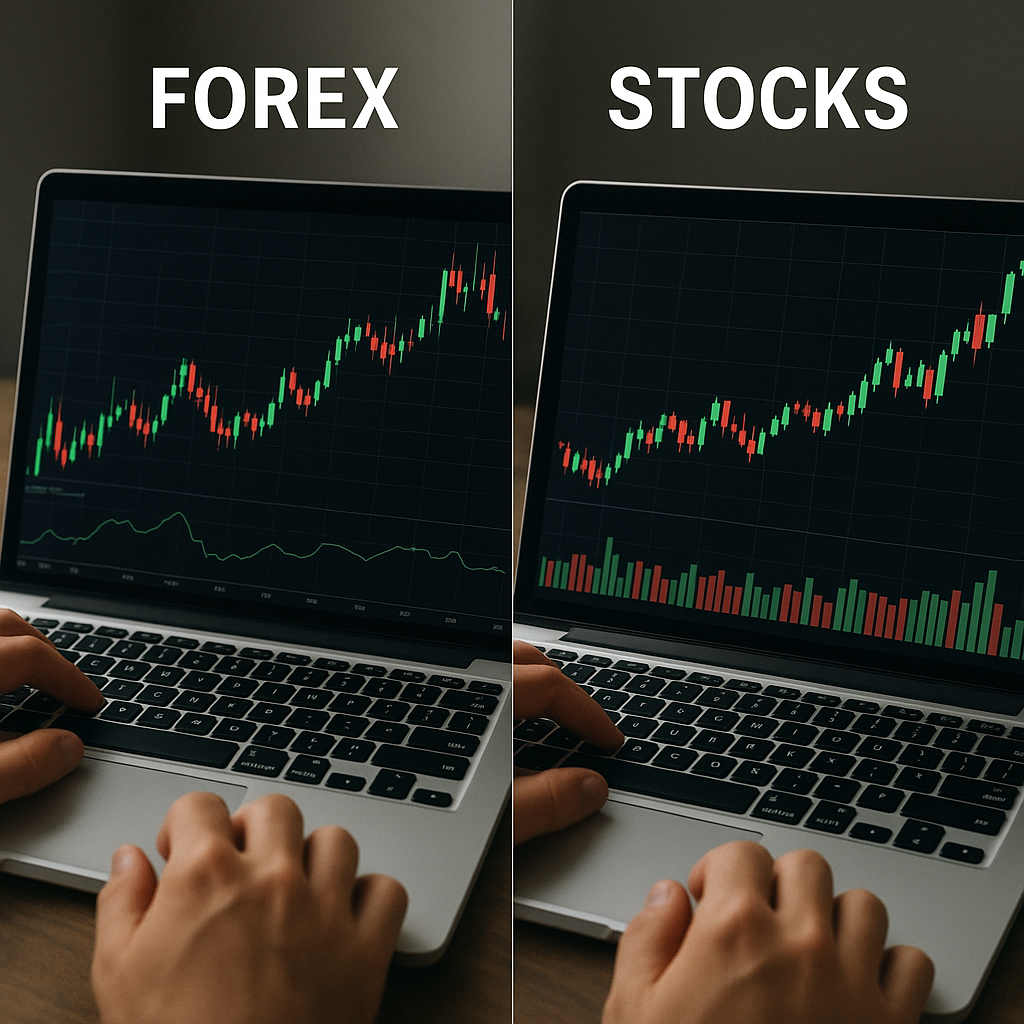
Technology and platforms also play a role. Forex brokers tend to provide advanced charting tools, automated trading features, and mobile apps optimized for rapid order execution. Stock trading platforms offer detailed company reports, analyst ratings, and portfolio tracking tools. The choice hinges on which interface and data sets align with your strategy.
Lastly, consider the psychological aspects. Forex’s fast pace can induce stress and overtrading, while equities often require patience during consolidation phases and market corrections. Understanding your emotional resilience will guide you toward the market that complements your temperament.
Integrating Forex and Stock Strategies
Some investors and traders blend Forex and stock approaches to capitalize on the strengths of both markets. For example, a trader might hedge currency risk by taking a short position in EUR/USD while holding European equities. Alternatively, an investor could diversify across international stocks and currency ETFs to balance exposure to different economic zones.
Cross-asset strategies can mitigate risk by taking advantage of non-correlated movements. When equities slump due to a domestic recession, foreign currencies or commodities might appreciate, offering a buffer against losses. Such advanced techniques require a deep understanding of macroeconomic linkages and solid risk controls.
- Carry Trade: Borrow low-interest currency to invest in a higher-yielding asset, often executed in Forex but adaptable to high-dividend stocks.
- Pairs Trading: Long one stock or currency while shorting another correlated instrument, aiming to profit from relative price movements.
- Global Macro: Position across currency, bond, equity, and commodity markets based on macroeconomic forecasts.
These hybrid methods demand robust research capabilities and continuous monitoring. However, they can enhance returns and provide a more resilient portfolio against market shocks.
Final Considerations
Deciding between Forex and stock trading involves evaluating factors such as market accessibility, capital requirements, and individual trading objectives. Both domains offer abundant opportunities but carry distinct risk profiles. By gaining a comprehensive understanding of their differences—market structure, costs, leverage, and volatility—you can craft a tailored strategy that aligns with your financial goals.
Ultimately, success in either market hinges on ongoing education, disciplined risk management, and adaptability to ever-changing conditions. Whether you choose the dynamic world of Forex or the diverse landscape of equities, mastering the fundamentals will empower you to navigate financial markets with confidence and precision.