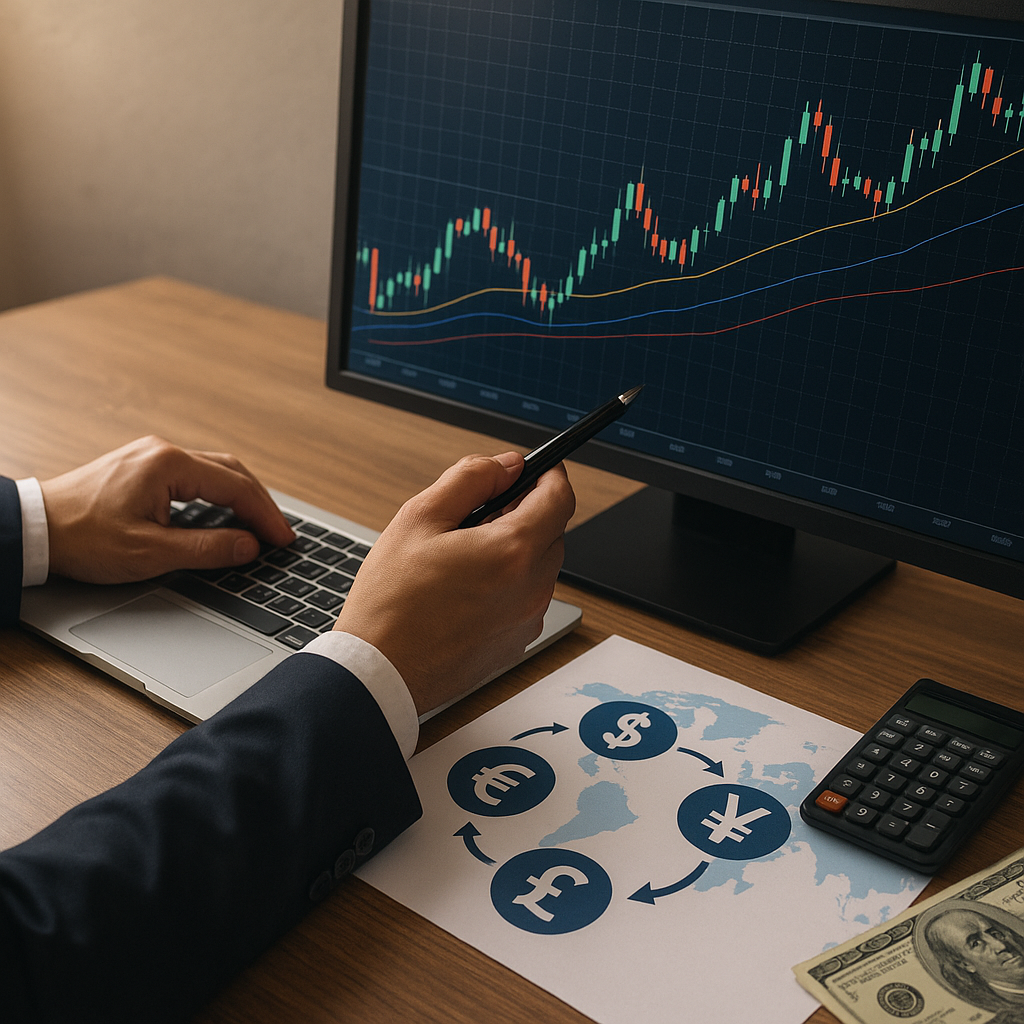
The foreign exchange market, often called the forex or FX market, is the global arena where currencies are bought, sold and exchanged. It operates continuously, linking banks, corporations, governments, investors and individual traders across time zones. Because money is the bloodstream of international trade, travel and investment, understanding how this market works is crucial for anyone exposed to cross‑border payments or global business. On platforms like data-security.business/, companies and professionals are reminded that the movement of capital goes hand in hand with the protection of sensitive information. The forex market may appear abstract, but every currency quote affects real prices, profits and risks. Learning its basic mechanisms helps make sense of central bank decisions, exchange‑rate news and the costs of sending money abroad.
What the foreign exchange market is
The foreign exchange market is a decentralized global network where participants exchange one national currency for another. Instead of existing in a single physical location, it runs electronically through trading platforms, interbank systems and communication networks connecting financial centers around the world. A currency is always priced in relation to another currency, so every transaction involves a pair, such as EUR/USD or USD/JPY.
Unlike stock exchanges, there is no central forex exchange. Large commercial banks, central banks, multinational corporations, hedge funds, brokers and retail traders are all linked in a web of bilateral relationships. Prices emerge from the interaction of supply and demand between these participants. Because of its worldwide scope and constant activity, the forex market is considered the most liquid financial market on earth.
Main functions of the forex market
The forex market exists to perform several key functions for the global economy:
- Currency conversion for trade and investment. Importers, exporters and investors use the market to convert revenues and costs from one currency into another.
- Price discovery. Continuous trading creates transparent exchange rates that reflect current information and expectations.
- Risk management. Companies and investors use forex instruments to hedge against adverse changes in exchange rates.
- Speculation. Traders seek profit by anticipating future movements in currency values.
- Arbitrage. Market participants exploit small price differences across venues, which helps keep rates aligned.
These functions support international commerce by making it possible to quote prices, settle contracts and manage risk in different currencies with relative ease.
Who participates in the forex market
Because the market is so large, it is helpful to understand the main categories of participants and their motivations.
Commercial and investment banks sit at the core. They act both as market makers, quoting bid and ask prices to clients and other banks, and as proprietary traders managing their own risk books. Large corporations participate to convert foreign revenues, pay overseas suppliers and hedge future cash flows. Tourism companies, airlines and global retailers are frequent users of bank forex services.
Central banks are another crucial group. They intervene to implement monetary policy, stabilize their currency or build and manage foreign exchange reserves. When a central bank buys or sells its own currency, it can influence both the level and volatility of its exchange rate.
Institutional investors such as pension funds, insurance companies and asset managers trade currencies as part of their global portfolios. When they buy foreign bonds or equities, they often need to manage the associated currency risk, sometimes hedging it fully, sometimes leaving it partially unhedged based on their strategies.
Hedge funds and proprietary trading firms pursue speculative strategies, attempting to profit from trends, interest rate differentials or macroeconomic themes. Their trading can be very active and sometimes amplifies short‑term market moves.
Finally, individual or retail traders access the market through brokers and online platforms. While each trader is small relative to institutional players, together they form a sizeable part of daily spot transactions, especially in popular currency pairs.
How currency pairs and quotes work
Every forex transaction involves a pair of currencies. The first in the pair is the base currency, and the second is the quote, or counter, currency. In the pair EUR/USD, the euro is the base and the US dollar is the quote. A rate of 1.1000 means one euro costs 1.10 US dollars.
Quotes are shown with two prices: the bid and the ask. The bid is the price at which a dealer is willing to buy the base currency, and the ask is the price at which the dealer is willing to sell it. The difference between them is called the spread. For major pairs, spreads are typically very tight, reflecting high liquidity.
Currencies trade in standardized quantities known as lots. In the interbank market, deals are often in millions of units, while retail brokers use standard lots of 100,000 units, mini lots of 10,000 and micro lots of 1,000. When the price changes in the fourth decimal place for most pairs, that movement is known as a pip, a basic unit for measuring price changes and calculating profit and loss.
Spot, forward and other forex instruments
The best known part of the forex market is the spot market, where currencies are exchanged for near‑immediate delivery, typically two business days after the trade date. Spot prices serve as a reference for many other instruments.
Forward contracts allow two parties to agree today on a currency exchange that will occur at a specified date in the future, at a predetermined rate. Forwards are usually traded over the counter and customized to the needs of companies or investors. They are widely used for hedging predictable cash flows such as future export receipts or loan repayments.
Futures contracts are standardized agreements traded on organized exchanges, where participants commit to exchange a fixed amount of currency at a set future date. Although the volume of currency futures is smaller than in spot and forwards, they provide transparent pricing and centralized clearing.
Options on currencies give the buyer the right, but not the obligation, to exchange a currency pair at a specific rate before or on a given date. They are more complex but offer flexible ways to manage risk, allowing hedgers to protect against adverse moves while still benefiting from favorable ones.
Currency swaps are longer‑term agreements where two parties exchange principal and interest payments in different currencies. They are common tools for corporations and governments that want to borrow in one currency but pay obligations in another.
How trading is organized
The forex market operates on a decentralized over‑the‑counter model rather than through a single exchange. Large banks quote prices to one another via electronic brokerage systems and communication networks. Wholesale clients then access those prices through relationship managers and trading platforms.
Retail traders typically use online brokers that provide access to liquidity aggregated from multiple banks or non‑bank providers. Brokers often run electronic platforms that show streaming quotes, charts and order tools. Behind the interface, orders are either matched internally against other clients or passed through to external liquidity providers.
Because there is no central order book, different platforms can display slightly different prices at the same moment. Arbitrageurs help keep these differences small by buying where a pair is cheaper and selling where it is more expensive until prices converge.
Trading hours and global sessions
The forex market operates around the clock during business days, opening with the start of trading in Asia on Monday morning and closing with the end of the New York session on Friday. This continuous operation is possible because financial centers in different time zones overlap.
Broadly, traders speak of the Asian, European and North American sessions. Liquidity tends to be highest when the European and North American sessions overlap, because a large number of banks and funds are active at the same time. During these hours, spreads are often narrow and large orders can be executed with limited market impact.
Activity patterns vary by currency. For example, pairs involving the Japanese yen are more active during Asian hours, while those with the euro or British pound usually see their highest volumes during the European session. Understanding these patterns helps traders choose when to place orders for the best combination of liquidity and volatility.
What moves exchange rates
Exchange rates respond to a wide combination of fundamental, technical and market sentiment factors. At the core are economic indicators such as inflation, employment, gross domestic product and trade balances. Stronger economic performance often supports a currency because it can lead to higher interest rates and attract investment.
Monetary policy decisions by central banks are especially powerful drivers. When a central bank raises interest rates, its currency may appreciate as investors seek higher returns. Conversely, rate cuts or unconventional policies like large‑scale asset purchases can weigh on a currency. Market participants constantly monitor policy statements and speeches to anticipate future moves.
Political events and geopolitical risk also matter. Elections, referendums, trade disputes and conflicts can create uncertainty, prompting investors to shift into or out of certain currencies. In times of tension, so‑called safe‑haven currencies, often including the US dollar, Swiss franc or Japanese yen, may strengthen.
Short‑term price action can be driven by order flow, technical trading signals and positioning data. Many traders use charts, patterns and indicators to identify possible support and resistance levels. When widely watched levels are broken, momentum strategies and algorithmic trading can accelerate moves.
Risk, leverage and margin
The forex market offers high liquidity and, through leverage, the ability to control large positions with relatively small amounts of capital. Leverage allows a trader to borrow funds from a broker to increase exposure. While this can amplify profits, it also magnifies losses, making risk management essential.
To open a leveraged position, a trader must post margin, a portion of the full value of the trade. If market movements cause losses that reduce the trader’s equity below a required level, the broker can issue a margin call or automatically close positions to limit further losses. Understanding these mechanics is vital for anyone using leverage.
Major risks include market risk from adverse price moves, liquidity risk when it becomes difficult to exit a position at the expected price, and operational risk linked to systems, connectivity and execution. For businesses, currency risk can directly affect profit margins if revenues and costs are in different currencies and are not properly hedged.
Role of technology and data
Modern forex trading depends heavily on electronic infrastructure. Banks, brokers and funds rely on fast connections, pricing engines and risk systems to quote, match and settle trades. Algorithmic strategies, which use predefined rules to trade automatically, now account for a significant share of volume, particularly in major currency pairs.
Because trading generates large amounts of sensitive information, from client orders to exposure data, secure handling of this information is crucial. Robust data protection, encryption, and access controls help protect both institutions and end users from fraud, manipulation and cyberattacks. This intersection of finance and cybersecurity grows more important as more activity moves online.
Data analytics and machine learning techniques are increasingly used to detect patterns in prices, study market microstructure and enhance risk models. However, even advanced systems cannot eliminate uncertainty, and human oversight remains necessary to interpret signals and manage exceptional situations.
How companies use the forex market
For many businesses, currency exposure arises naturally from cross‑border operations. Exporters may receive revenues in foreign currencies, while their costs are in domestic currency. Importers face the opposite situation. Without hedging, unexpected movements in exchange rates can erode profit margins or even turn profitable deals into losses.
Companies commonly use forward contracts to lock in exchange rates for future payments or receipts, providing predictability. Some use options strategies to protect against sharp adverse moves while retaining upside potential if rates move in their favor. Treasury departments often design policies that define acceptable levels of currency risk and the tools allowed for hedging.
Multinational groups face additional issues, such as translation risk when consolidating the financial statements of foreign subsidiaries. Changes in exchange rates can alter reported revenues and assets even if underlying operations are stable. Managing these exposures requires coordination between local finance teams and group treasury functions.
How individuals encounter the forex market
Even people who never trade currencies directly interact with the forex market in daily life. Travelers converting cash at an exchange office, students paying tuition abroad, or families sending remittances all depend on exchange rates. The prices they see often incorporate a spread and service fees, which are, in effect, the retail face of the wholesale market.
Many individual investors gain indirect currency exposure by buying foreign stocks, bonds or funds. The value of these investments in their home currency can rise or fall not only because of asset prices, but also because of movements in exchange rates. Some global investment products use hedging strategies to reduce this currency impact.
Retail traders who speculate directly in forex usually do so through margin trading accounts offered by brokers. These traders must be aware of the high risk associated with leverage, the importance of position sizing and the need for clear stop‑loss rules. Education, discipline and a realistic assessment of one’s financial situation are critical.
Regulation and market integrity
Because the forex market is decentralized and global, regulation is complex and varies by jurisdiction. National regulators oversee brokers, banks and trading venues within their borders, setting rules on capital requirements, reporting, client protection and conduct standards. After past scandals involving manipulation of reference rates, authorities have strengthened oversight and encouraged codes of conduct for market participants.
Market integrity depends on transparent pricing, fair access to liquidity and the proper handling of client orders. Institutions invest in compliance systems to monitor trading behavior, prevent abuse and ensure that communications and records are maintained securely. Robust internal controls and periodic audits support trust in the system.
The importance of education and risk awareness
Understanding how the foreign exchange market works is essential for policymakers, businesses and individuals who interact with the global economy. While the market provides indispensable services – facilitating trade, investment and capital flows – it also carries significant risks for those who participate directly.
Education about fundamental drivers, market mechanics, instruments and risk management can help participants make better decisions. For companies, this may mean developing clear treasury policies and using hedging tools appropriately. For individuals, it means recognizing that leverage and volatility can produce rapid losses as well as gains.
As technology continues to evolve, and as financial and digital systems become more interconnected, the link between secure transactions, reliable infrastructure and sound currency management will grow even tighter. A well‑functioning foreign exchange market, supported by strong governance and careful risk controls, remains a cornerstone of global economic activity.

